Pillows · Natural sleep materials
Healthy Choice Wool Pillows: Fill, Feel, and Care Considerations
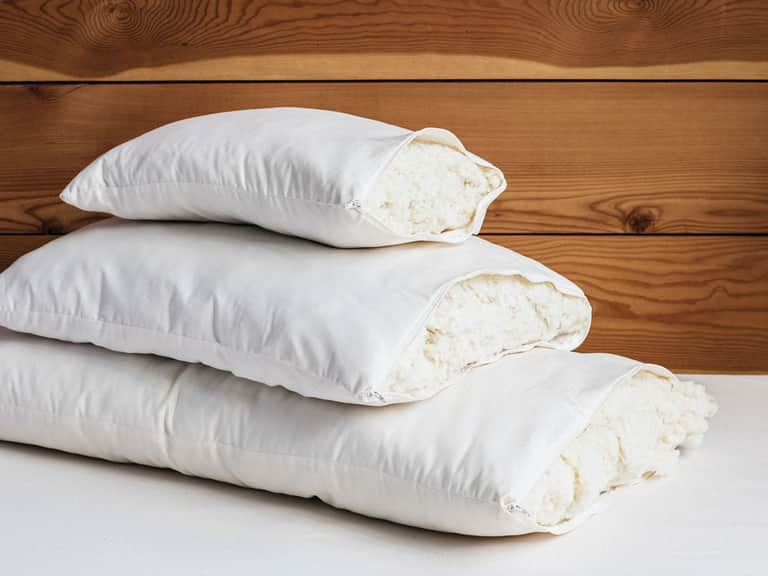
A pillow’s comfort is not simply a matter of softness. Its fill, height, resilience, and care requirements all shape how it feels night after night. The Healthy Choice Organic Wool Pillow pairs wool batting with an organic cotton sateen cover—a natural-material combination worth understanding before you decide whether it suits your sleep preferences.
Published November 15, 2026
For many sleepers, choosing a pillow begins with a familiar question: soft or firm? But that binary leaves out much of what matters. A pillow can feel plush in the hand yet offer too little support beneath the head. Another may seem substantial at first and settle into a different shape during the night. Fill behavior, pillow height, sleeping position, and the sleeper’s own comfort all contribute to the experience.
Wool offers a different feel from common synthetic fills, while a cotton cover brings another layer of texture and breathability into the equation. The Healthy Choice Organic Wool Pillow is described as having GOTS-certified organic wool batting and a GOTS-certified organic cotton sateen cover. It is offered in standard, queen, and king sizes, and it is not adjustable. Its care instructions call for spot cleaning rather than routine machine washing.
Those details are useful starting points, not a promise that any particular pillow will improve sleep or relieve discomfort. The practical question is whether this construction, feel, and upkeep suit your habits. Understanding what wool can mean in a pillow—and what it does not guarantee—makes it easier to make a grounded choice.
What is inside a Healthy Choice wool pillow?
The pillow combines two materials: wool batting in the core and an organic cotton sateen cover. The wool is described as GOTS-certified and sourced from Argentina; the cover is also described as GOTS-certified organic cotton sateen. Certification can help shoppers assess how products and materials were produced under the relevant standard, but it does not tell you whether the pillow’s shape or firmness will feel right for your body.
Wool batting is made from fibers arranged in a soft, filled structure rather than a single molded block. Compared with a solid core, a batting-filled pillow may feel more yielding and less uniformly shaped. Its behavior depends on details such as the amount and arrangement of fill, as well as how the pillow is used and maintained. The Healthy Choice description characterizes the pillow as fluffy and breathable; those terms describe its intended material experience, but individual impressions will vary.
The cover matters, too. Cotton sateen is a weave that typically feels smoother and more drapable than crisp cotton percale. It is not a separate fiber: the pillow’s outer fabric is cotton, while sateen describes the way that fabric is woven. The result may feel soft against the face, though the sensation depends on the fabric’s finish, laundering, and personal preference.
For readers comparing Healthy Choice pillows with other natural pillows, the material label is only one part of the decision. Consider whether you want a pillow that can be reshaped or adjusted, how much loft you need, and whether you are comfortable with a fill that is not intended to be washed at home.
How wool fill may feel in use
Wool is a natural fiber known for its insulating qualities and ability to interact with moisture. In a pillow, those properties may contribute to a less clammy-feeling sleep surface for some people. That is not the same as a guarantee that a wool pillow will keep every sleeper cool. Room temperature, bedding layers, the sleeper’s own heat regulation, and the pillow’s construction all play a role.
Wool fill can feel soft and compressible, but “soft” does not automatically mean “low support.” Support is about how a pillow holds the head in relation to the shoulders and torso. The important thing is whether the pillow’s loft and resistance feel suitable in your usual sleeping position. A pillow can be comfortable for one sleeper and too high, low, or yielding for another.
The Healthy Choice pillow is not adjustable. That is a meaningful distinction. Some wool pillows use a zippered case and loose fill that can be added or removed; this one is described as a fixed, non-adjustable pillow. If you know you often change pillow height, or you like to fine-tune the amount of fill, a fixed construction may not offer the flexibility you want. If you prefer a ready-made shape and do not expect to alter it, that limitation may matter less.
Wool should not be treated as a medical intervention. Claims that a pillow will prevent neck pain, correct posture, or resolve a sleep problem go beyond what material information alone can establish. If you wake with persistent pain or numbness, or have ongoing sleep concerns, a pillow change may be only one small part of the picture. A qualified health professional can help assess symptoms and next steps.
Match loft and support to your sleep position
Sleep position offers a useful starting point when considering pillow height, though it is not a rigid formula. Body proportions, mattress firmness, shoulder width, and personal comfort affect how much space a pillow needs to fill. Think of the goal as finding a comfortable, reasonably neutral head-and-neck position—not achieving a single ideal shape that applies to everyone.
- Side sleeping: A pillow needs to fill the space between the head and mattress without pushing the head sharply upward. Shoulder width and mattress softness can change how much loft feels appropriate.
- Back sleeping: Many back sleepers prefer a moderate height that supports the head without tipping the chin too far toward the chest. Individual comfort remains the deciding factor.
- Stomach sleeping: Some stomach sleepers find a lower, softer pillow more comfortable. A pillow that feels too tall may create an awkward angle, but preferences differ.
- Combination sleeping: People who change positions may want to notice whether the pillow remains comfortable when they move, rather than judging it from one position alone.
Because the Healthy Choice pillow is not adjustable, choosing the size and construction thoughtfully matters. The listed standard, queen, and king options refer to pillow dimensions, not different support levels. Before choosing, check the available dimensions and consider your pillowcase, bed setup, and preferred amount of surface area. A larger pillow is not necessarily taller or more supportive.
When possible, assess a new pillow over a realistic period and pay attention to how it feels in your usual position. Avoid drawing a conclusion from a quick squeeze in a store: hand feel does not fully predict how a filled pillow will behave beneath the head. If the seller provides a return or trial policy, read its terms before purchase, including any requirements for packaging, timing, or condition.
The cotton sateen cover: a close-up consideration
The cover is the first part of a pillow that touches the face, so its texture and maintenance can matter as much as the fill. Cotton sateen generally has a smoother hand than percale and a subtle surface sheen. Some people enjoy that soft, draping feel; others prefer the crispness of a plain-weave percale fabric. Neither preference is more correct.
A removable, washable pillowcase or protector can provide a practical layer between the face and the pillow itself. That is especially relevant when the pillow’s own care instructions call for spot cleaning only. A separate protector may help limit everyday soil reaching the pillow, but it should be selected so it does not make the sleeping surface feel too warm, noisy, or restrictive for your taste.
Organic describes a production standard, not a guarantee that a material is appropriate for every individual. People can have sensitivities to many substances, including natural fibers. If you have a known wool sensitivity, or have had reactions to bedding materials in the past, review the materials carefully and consider seeking guidance from a clinician when needed.
Wool pillow care: why spot cleaning matters
Care instructions are easy to overlook when shopping, but they can determine whether a pillow fits the realities of your household. The Healthy Choice Organic Wool Pillow is listed as spot clean only. Its guidance also recommends using a pillow protector and avoiding direct sunlight or a direct heat source. These instructions are not interchangeable with the laundering directions for a removable pillowcase or a different wool pillow.
Washing a whole pillow without checking its label can create problems. Water, agitation, heat, or prolonged dampness may affect a filled item’s shape and texture. Even if a pillow’s cover looks sturdy, that does not mean the complete pillow is machine washable. Follow the care instructions supplied with the specific item, and contact the seller or manufacturer if those directions are unclear.
A cautious approach to a small spot
- Check the care label and confirm that the mark can be treated with spot cleaning.
- Blot fresh moisture gently with a clean, absorbent cloth. Avoid rubbing, which may spread a stain or work it further into the fabric.
- Use only a modest amount of an appropriate cleaning method, following the manufacturer’s instructions. Do not soak the pillow.
- Blot away remaining moisture and allow the pillow to dry fully in a well-ventilated place before using it again.
- Avoid direct heat and direct sunlight, as specified in the product care guidance. Do not put the pillow back on the bed while it is damp.
This is a general, conservative method for thinking about spot care, not a substitute for product-specific instructions. If a stain is extensive, if the pillow is heavily soiled, or if the care label does not address the situation, ask the manufacturer before trying a stronger cleaner or a full wash. Do not assume that a method suitable for a removable cotton cover is safe for wool batting.
Using a washable protector can reduce the need to clean the pillow itself. Choose one sized to fit properly and wash it according to its own label. Regularly airing bedding in a dry, shaded, ventilated space may help it feel fresh, but airing does not replace cleaning when cleaning is needed, nor should it override the pillow’s care directions.
What “organic” and certification can tell you
Labels such as GOTS are often part of the decision for shoppers seeking organic textiles. A certification is useful because it offers a framework for evaluating claims about materials and production. Still, certification and comfort answer different questions. A verified material claim cannot tell you whether the pillow will suit your sleeping position, whether you will like its feel, or whether its cleaning limits fit your routine.
Read descriptions precisely. The product information identifies organic wool batting and an organic cotton sateen cover, and names GOTS certification for those materials. When comparing products, look for details about which component is certified, what the certificate covers, and whether the listing provides clear care instructions. Broad language such as “natural” is not, by itself, a detailed account of every material or manufacturing step.
Also distinguish between the properties of a fiber and claims about a finished product. Wool has particular characteristics as a material, but a pillow’s performance depends on the complete construction. Fill quantity, cover fabric, stitching, size, and use all influence the result. A thoughtful comparison focuses on those specifics rather than relying on a single label as a shortcut.
A practical checklist before choosing
Before deciding whether this organic wool pillow belongs in your bedroom, work through a few everyday questions. A natural-material choice is most useful when it suits the person who will sleep on it—not merely when its material description sounds appealing.
- Do you like a soft, filled feel? Wool batting is not the same as a rigid molded core. Consider whether a compressible pillow sounds comfortable to you.
- Do you need adjustable loft? This pillow is not adjustable. If you routinely add or remove fill, look for that feature explicitly in another design.
- Does its size suit your setup? Check standard, queen, or king dimensions against your pillowcase and preferred coverage.
- Can you work with spot-clean-only care? If you need bedding that can be fully machine washed, this care requirement may be a deciding limitation.
- Will you use a protector? A removable, washable layer can make routine upkeep easier while keeping the pillow itself out of the wash.
- Have you checked the full materials information? Review the cover, fill, and any care or sensitivity considerations before purchasing.
- Do the return terms make sense? A pillow’s true feel is personal. Check the seller’s current policy rather than assuming a trial period is available.
A natural pillow is still a personal choice
The appeal of a wool pillow is not that one fiber can solve every sleep concern. It is that a natural fill and cotton cover may offer a different combination of texture, breathability, and material sourcing from a conventional synthetic pillow. For some sleepers, that combination is compelling. For others, adjustability, easy washing, or a more structured feel will take priority.
The Healthy Choice Organic Wool Pillow has a clear profile: wool batting, an organic cotton sateen cover, standard through king sizing, no loft adjustment, and spot-clean-only care. Those specifics make it easier to compare with other natural pillows without turning a material preference into a health claim. The right question is not whether wool is universally better. It is whether this particular fill and maintenance routine work for you.
Take the time to consider support, sleep position, cover texture, cleaning habits, and the product’s exact care label. In bedding, the most useful choice is often the one that balances comfort with the less glamorous details of everyday use. A pillow that feels pleasant at bedtime and remains manageable to care for has a stronger chance of earning a lasting place on the bed.